
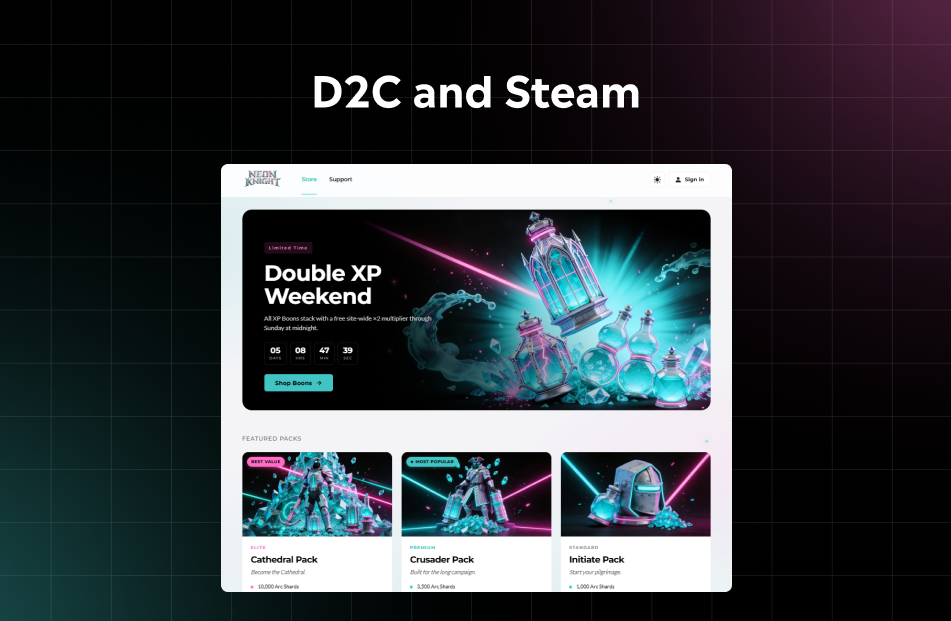
Ask most PC game studios and publishers about selling direct to consumer and one of the first questions that comes up is about how D2C fits in with offering the game on Steam.
- Will a store outside Steam break the rules?
- Will it cannibalize the game sales on Steam?
- Will it just move the same sales from one place to another?
These are all fair questions. Steam is where most PC players find and buy games - with 42 million peak concurrent users according to their year in review in 2025 - and most D2C launch strategies will understandably run alongside Steam for their discoverability power.
Can I Sell D2C Alongside Steam?
The truth is that the answers are clearer than they seem.
In fact, Valve built Steam keys so studios can sell their games on other stores, and its Steam Key documentation spells out the rules that come with them.
As long as your studio follow these rules, they can run their own D2C webstore or checkout next to Steam.
The benefits to selling D2C are numerous and go beyond just a higher margin of each game sale. Some of biggest value-ads to running a D2C store includes
- Building and maintaining a direct relationship with the community
- Owning the transaction data for greater control over how games are sold
- The ability to offer their own liveops and special bundles and even editions Steam doesn't support
Here's a deeper dive into what Steam’s documentation says, where the lines are, and what running D2C and Steam stores for your games looks like in practice.
What Valve's documentation allows
Steam keys are built for other stores
Valve's Steam Keys documentation describes keys as a way to "sell your game on other stores and at retail", and keys are a free service.
Studios can request keys for anything available on Steam, including DLC, and Valve's DLC documentation confirms that DLC can be registered with a key as well as bought in the Steam store.
For the buyer, it's simple. They pay on the studio's store, get a Steam key by email, redeem it on Steam, and the game or DLC appears in their Steam library.
The rules that come with Steam Keys
Keys come with a short set of conditions, all from the same Steam Keys page:
- Price parity. Steam customers should never get a worse deal than key buyers. A discount elsewhere is fine if a comparable offer follows on Steam "within a reasonable amount of time".
- Volume is reviewed. A launching game can request up to 5,000 release keys by default. Beyond that, Valve reviews requests against the game's Steam sales and turns down requests that are far out of line.
- Never sell beta keys. Release State Override keys are for testing only.
- Unlock at release. Pre-order keys should activate when the game goes on sale on Steam.
- Follow Valve's branding guidelines wherever keys are sold.
Purchases inside the Steam build
Inside the Steam version of a game, purchases go through Steam.
Valve's microtransaction documentation says Steam customers can only buy with their Steam Wallet, and its review checklist says a product cannot link to other store pages that don't offer Steam Wallet.
In practice, that means no external "buy here" buttons, links or third-party checkout inside the Steam build, and no links to other stores in the Steam store page description.
The direct store lives on the studio's own channels: its website, its community and its newsletter.
Granting items bought on the web inside the Steam build is a separate question, and Valve's documentation doesn't address it directly. If that's part of your plan, talk to us about your setup.
Will a direct store take sales from Steam?
This is the worry behind most hesitation about selling direct.
To nip the concern in the bud: a direct-to-consumer store done properly isn't competing with Steam for the same sale.
Across Tebex’s network of game stores, including D2C stores for PC studios and publishers like Bohemia Interactive and MADFINGER Games, the direct channel is additive and has an opposite effect than cannibalizing Steam sales.
In other words, the pie gets bigger, instead of the stores fighting over the same slice.
There’s a few reasons for that:
Price parity means the store doesn't compete on price.
Valve asks that Steam customers never get a worse deal than key buyers, so a direct store can't win by undercutting Steam, and it shouldn't try. Your D2C store wins on what Steam doesn't offer: bundles and editions the studio designs, offers timed to its own roadmap, and a checkout under its own brand.
The two channels do different jobs.
Steam is built for discovery. It shines as a channel to put game in front of people who have never heard of it or your studio.
A direct store serves the people who already have: the community on Discord, the newsletter list, the visitors to the studio's site. That traffic belongs to the studio, and giving it a place to buy is not the same as taking a buyer away from Steam.
The player still ends up on Steam.
A Steam key bought on the studio's store redeems on Steam, and the game appears in the player's Steam library. They play, update and join the community there like any other owner.
The relationship stays with the studio.
Every direct sale comes with something a platform sale doesn't: the buyer’s info, purchase history, and trends that enable you to better understand your cohorts.
That's the long-term value of selling direct, and it builds on every purchase on your webstore, but not on Steam.
What it looks like in practice
When MADFINGER Games launched Gray Zone Warfare in Early Access on Steam, they wanted a direct store from day one. Tebex worked with them on a custom webstore that runs alongside Steam, along with the go-to-market around it.
You can see how MADFINGER games launched in both Early Access and D2C in our partner spotlight video here:
What it takes to run a store alongside Steam
Running both sales channels well comes down to a few things working without the studio needing to take away developer time to build and maintain them:
- Keys delivered the moment someone pays, from stock the studio can top up any time, with a record of which key went to which buyer.
- Tax, fraud and chargebacks handled in every market the studio sells to.
- A store that fits the studio's brand, hosted or built into its own website.
- Separate tooling for builds outside Steam, such as the studio's own launcher, kept out of the Steam build.
This is the work Tebex does for game studios.
As the Merchant of Record for every purchase in our network, Tebex collects and remits VAT and sales tax worldwide and prevents fraud on an ongoing basis.
It’s also the only MoR to fully protect against chargebacks - even if the studio loses the dispute claim.
Studios and publishers can sell Steam keys and DLC keys through Tebex's License Key deliverable, on a hosted Tebex webstore or on a storefront the studio builds itself with the Headless API.
In short, the studio decides what to sell and when. Tebex runs the store, payments, tax and fraud behind it, as the monetization team the studio never had to hire.
Do and don't for selling D2C while staying compliant with Steam
Steam and a direct store work best together
Selling direct isn't a move away from Steam. Valve's own rules make room for it, and the studios that do it well use each channel for what it does best: Steam to reach new players, their own store to serve the ones they already have.
Planning a store alongside Steam? Our team can walk you through the setup.
Disclaimer: this article summarizes Valve's public Steamworks documentation as of November 2026. It is not legal advice. Please reach out to the Tebex team for any questions about your specific store or sales strategy.